Made in Texas • Ships Uncompressed • CAL TB117-2013 Compliant

Why Your Room Sounds Bad: The 5 Most Common Acoustic Problems (and How to Fix Them)
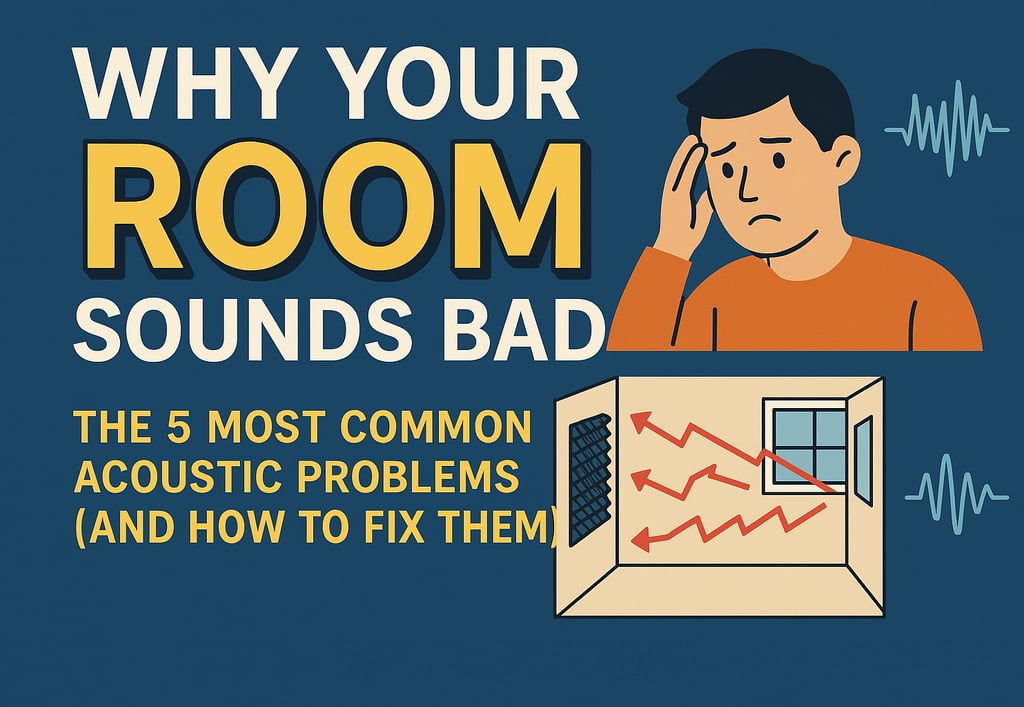
If your room sounds echoey, boomy, hollow, or just plain off, you’re not alone. Almost every bedroom, office, home studio, and gaming setup has some kind of acoustic issue. And for most people, the surprising part is this: It’s usually not your microphone, your speakers, or your computer. It’s the room itself. In this guide, we’ll break down the five most common reasons rooms sound bad and the simple ways you can fix each one — even if you’re working with a small space or a tight budget.
12/3/20254 min read
1. Echo & Reflections — “Why does everything sound so harsh?”
If your voice or music seems sharp, shrill, or tiring to listen to, chances are your room has too many reflective surfaces.
Bare walls, tile floors, windows, big desks, and even flat ceilings all bounce sound around. When those reflections reach your ears (or your mic) a split second later, they blur the original sound and make everything muddy.
How to tell if this is your problem
Clap your hands.
If you hear a long “shh” or “zing” afterward, that’s slap echo.Record yourself talking.
If it sounds metallic or like you’re in a bathroom, your room is too reflective.
How to fix it
You need to add sound absorption — not soundproofing.
Foam panels work great for mid and high frequencies:
Wedge foam
Pyramid foam
Flat face panels
Any 1–2 inch USA-made acoustic foam
Treat the areas sound hits first: walls near your voice, above your desk, behind your mic, and at ear level.
Even 6–12 well-placed panels can make a dramatic difference.
2. Boomy Bass & Muddy Low End — “Everything sounds like it’s in a barrel.”
Low frequencies behave differently than mids and highs. Instead of bouncing lightly around the room, bass tends to pile up in the corners, behind furniture, and along walls. That’s why some spots in the room sound overly loud while others sound thin.
How to tell if this is your problem
Music sounds muddy or “thick”
Your recordings have a hollow, low rumble
The low end suddenly gets loud when you move closer to a wall
Your headphones sound clear, but your room does not
How to fix it
This is where bass traps come in.
Bass traps are thicker, denser foam pieces placed in corners to absorb low-frequency build-up. You don’t need to treat the entire room — just the main corners where pressure collects.
For best results:
Rear wall corners are the #1 priority
Front corners help stabilize your stereo image
Ceiling corners are a bonus if you’re really dialing in your space
This is the most overlooked treatment by beginners, but it’s also one of the biggest improvements you can make.
3. Flutter Echo — “My voice keeps bouncing back and forth.”
Flutter echo happens when two parallel walls ping sound back and forth between each other. Bedrooms, apartments, offices, and modern homes are basically rectangles… so this problem is insanely common.
How to tell if this is your problem
Do the clap test again — but listen closely.
If you hear a quick, rapid bouncing sound (almost like “prrr-prrr-prrr”), that’s flutter echo.
How to fix it
You don’t need to cover the whole wall. You just need to break up the perfectly smooth, parallel surfaces.
Good fixes include:
A strip of acoustic foam panels
A few scattered 12x12 panels on each wall
A bookshelf or wall décor (helps visually and acoustically)
Putting 4–6 foam tiles in strategic spots kills flutter almost instantly.
4. Uneven Sound — “Why do some spots sound good and others sound terrible?”
Rooms don’t distribute sound evenly. You might notice:
One corner sounds boomy
One spot sounds dead
One area has weird high-frequency ringing
Your speakers sound great where you sit but terrible two feet over
This is caused by standing waves, reflections, and the shape of the room.
How to tell if this is your problem
Move around your room and listen to music.
If the sound changes dramatically depending on where you stand, this is you.
How to fix it
Spread absorption throughout the room instead of clustering it all in one place. A balanced setup stops reflections from overpowering certain areas.
Try:
A row of panels behind your speakers
A couple panels behind your chair
Some panels on the side walls
One or two on the ceiling above your desk (optional but effective)
This gives you a more even, natural sound everywhere.
5. Confusing Sound Treatment with Soundproofing — “Why can I still hear noise from outside?”
This is the #1 misconception people have.
Acoustic foam improves sound inside your room.
Soundproofing stops sound from entering or leaving the room.
They are completely different things.
Foam helps with:
Echo
Voice clarity
Recording quality
Harsh reflections
Boomy bass
General room improvement
Foam does NOT block:
Loud neighbors
Street noise
Footsteps upstairs
Thin apartment walls
People often buy foam expecting silence — and when the room still lets noise in, they assume the foam didn’t “work.”
Quick Fix Checklist to Improve Any Room (5 Minutes or Less)
Here’s what almost anyone can do today:
Move your setup away from a corner
Add a few foam tiles on the wall behind your mic
Treat the wall directly across from you
Put a soft rug down if you have tile or hardwood
Add bass traps to the main corners
Hang a curtain over a bare window
Add just one foam panel on the ceiling above your desk (secret weapon)
Even tiny changes stack up fast.
Recommended Acoustic Starter Setups
You don’t need hundreds of dollars of treatment. Here’s what most people actually need:
Starter Room Setup
24 foam tiles (2" wedge or pyramid)
Great for echo + clarity.
Content Creator / Streamer Setup
48 tiles
4 corner bass traps
Perfect for voice recording and mic clarity.
Home Studio Bundle
64 tiles (depending on size of room)
4–8 corner traps
A few ceiling tiles
Best for musicians, podcasters, editors.
Each of these can be tailored to the user’s room size and layout.
Final Thoughts
A bad-sounding room isn’t your fault — and it’s definitely not a sign that you need expensive gear. Most rooms just aren’t built with acoustics in mind, so almost every space needs a little help.
If your audio sounds echoey or muddy, it’s not you.
It’s your walls.
The good news? Once you treat the room itself, everything else improves automatically — your recordings, your music, your streams, your voice clarity, even how loud you can listen without bothering anyone.
Ready to fix your room’s sound?
If you want a simple, affordable way to clean up echo and tighten up your space, our USA-made acoustic foam panels are a fast, effective upgrade. We ship quickly, never compress our foam, and offer sizes that fit any room.
Sound Trap Acoustics
Premium acoustic foam panels made in the USA — shipped uncompressed for consistent quality and performance.
Support
Contact US
contactus@soundtrapacoustics.com
© 2025. All rights reserved.